



Discovering the world through photography
July 25, 2009 by Richard McGuire · Leave a Comment
Southwestern Ontario, especially along the north shore of Lake Erie, is a unique corner of Canada. Because of its southerly latitude and the climate modifying effects of shallow Lake Erie, it has a climate and vegetation unlike that anywhere else in Canada. In fact, they refer to the tall deciduous forests as “Carolinian” because of their similarity to the Carolinas in the U.S.
It’s often referred to somewhat jokingly as the “banana belt” because of this climate. Of course no bananas grow, but you’ll see trees like cottonwoods and other more southerly species. And the farms grow products like tobacco and tomatoes. At Point Pelee, the southern tip of mainland Canada, my GPS showed a latitude of 41º 54′ 32″ — roughly the latitude of Istanbul, Rome, Barcelona and northern California.
Like many other parts of southern Ontario, away from the areas that have been filled with urban sprawl in recent decades, southwestern Ontario has many old Loyalist communities with beautiful old stone buildings.
Other than one brief previous journey, I’d never really visited this region before, except passing through on the 401 freeway. This was a chance to get onto the back roads and photograph some of the rural settings.
Here are a few shots I took of the area. I selected these to be representative, and they aren’t necessarily the best shots.
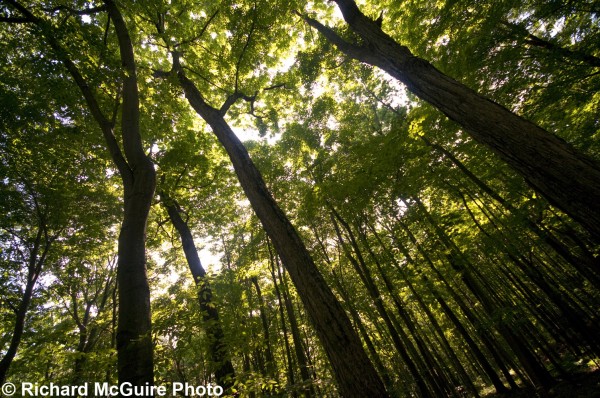
Carolinian forest, near Port Rowan, Ontario - © Richard McGuire
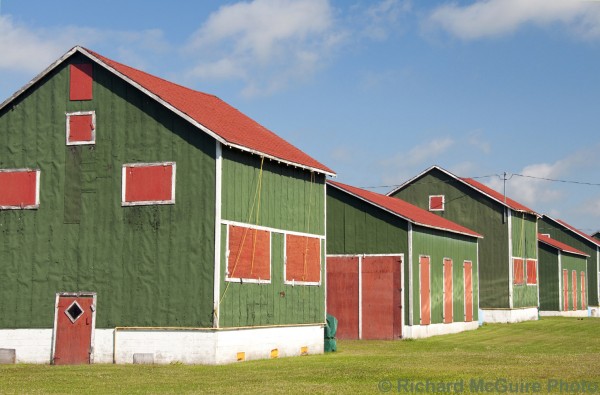
Tobacco barns, near Delhi, Ontario - © Richard McGuire
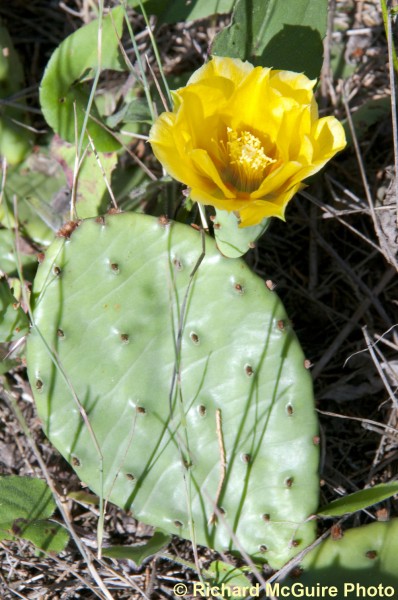
Prickly pear cactus, Point Pelee, southern Ontario - © Richard McGuire
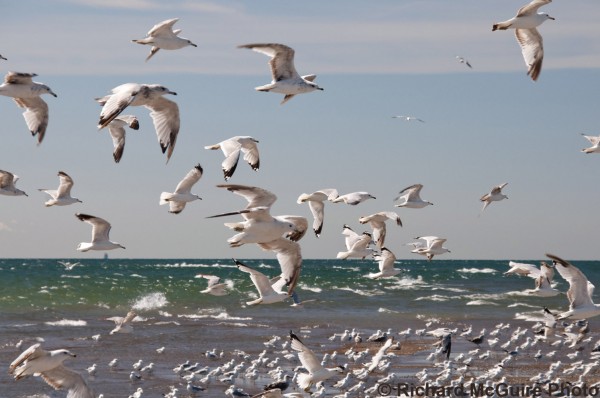
The end of Canada -- Point Pelee, Ontario - © Richard McGuire
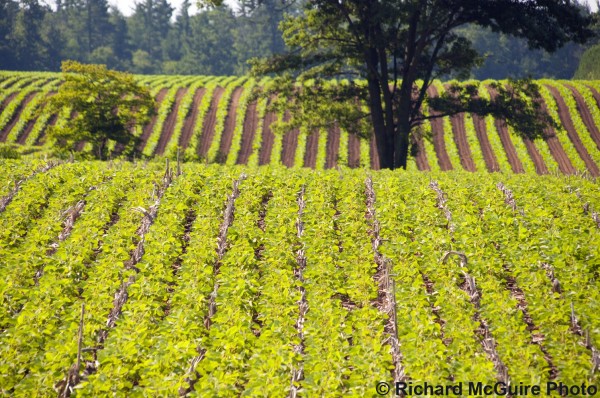
Crop rows, Delhi, Ontario - © Richard McGuire
July 5, 2009 by Richard McGuire · Leave a Comment
I began this blog for the one-time purpose of a trip to Central America in the winter of 2008-09.
It’s now time to give it a new life.
I plan to write about my interest in photography, and also about the subjects of my photos — often the backroads of Ontario and Quebec, or the streets of their cities.
I am currently on a trip to southwestern Ontario, the shores of lakes Erie and Huron, a part of Ontario I know the least.
I’ll post a few notes and photos from my journey.
January 18, 2009 by Richard McGuire · Leave a Comment

January 16, 2009 by Richard McGuire · Leave a Comment
I’m now in Cancun in the same hotel where this adventure started exactly five weeks ago. This afternoon I fly to Chicago and then on to Ottawa, if my plane doesn’t hit geese and try to land on Lake Michigan.
Mid-January is not a great time to return to Canada, but I’ve been blessed with several weeks of great weather while most Canadians suffered in cold. Still, the weather in Ottawa looks to be right now about the worst of the season. And never in my wildest dreams did I think a transit strike in Canada’s capital would be allowed to go on for five weeks. My arrival will be lots of fun, because I left my winter coat at home.
When people down here ask about Canada, they know it’s very cold and there’s lots of snow. But most, except those who’ve been to North America, have no real concept of it. Ice is something you put in drinks, and they’ve seen snow on TV, but here if it goes down to 15C, people say it’s cold. One British expatriate in Belize just shook his head when I said it was minus 20 in Ottawa that day: “Why would anyone live there?” Good question, though I do love those few weeks of tulips and autumn colours.
I’ve met several retired or semi retired people from North America who live down here. At Lake Atitlan in Guatemala, which must have one of the best climates in the world, I met Ron, who retired there and rents a two-bedroom house for less than $100 a month. He says he could never afford to live on his pension in the U.S., but here he lives well. He strikes up conversations with tourists, and he lives with two females — a dog and a cat. The four-legged kind of female, he says, is much more affordable than the two-legged kind.
Another semi-retired man, originally from Alberta and Saskatchewan, who I met yesterday on his way to Belize, lives in Puerto Vallarta, Mexico, and does metal art. He was on his way to Belize to look into setting up a store in the tourist zone where the cruise ships arrive. He spends his summers in Ketchican, Alaska.
Returning to Mexico is interesting after Guatemala and Belize. It seems so developed and relatively first world, even outside Cancun. The poverty and crumbling infrastructure in Guatemala and Belize are a sharp contrast to Mexico’s relative prosperity. Of course, traveling the other way, from north to south, Mexico’s poverty compared to Canada and the U.S. is more evident.
Soon it’ll be time to head to the airport. I don’t feel ready.
January 14, 2009 by Richard McGuire · Leave a Comment

Orange Walk is a community mainly of mestizos and largely Hispanic, though the surrounding area has a number of Mennonites. And of course almost every store and restaurant in Orange Walk is run by Chinese. It’s also the starting point for a river trip to the ancient Mayan city of Lamanai.
I arrived Monday night and booked a place with a small group going with a guide on Tuesday. Unfortunately, Tuesday started off as pouring rain, and I was soaked before I even found a place for breakfast. A German couple at my hotel backed out of the tour, but I figured, and the local people said, that the rain wouldn’t last and would soon clear up. I figured wrong.
I enjoyed the trip nonetheless, but was completely soaked. I wrapped my camera in plastic, but everything else got wet. The rain did let up for a while at Lamanai, but it rained continually during the river trip there and back.
The guide, Melvis, took me alone about seven miles up the river before we met five other tourists who were also coming. Along the way he pointed out bird after exotic bird in the thick foliage at the sides of the river or flying overhead: many herons, including great blue, who migrate from the north, a rare tiger heron, snowy egrets, parrots, a keel billed toucan, vultures, and numerous others. Melvis knew his birds. The river is infested with crocodiles, but as Melvis explained, in the cooler rainy weather, they tend to remain submerged in the water, rather than sunning themselves on the banks, as they do normally. Still, he saw one slip into the water, though I missed it.
Lamanai’s name, according to one interpretation of the Mayan languages, means City of Submerged Crocodiles. It’s an appropriate name, given that crocodiles seemed to have spiritual significance, and were certainly present.
The city itself consists of many hundreds of excavated, partly excavated, and buried buildings. There were a couple impressive temples, one of which I climbed on the steep stone steps, but generally there was less to see than in other cities such as Tikal. It was the setting in the jungle at the end of the winding river journey that made it an interesting experience.
Today, Wednesday, I took a short journey to the seaside town of Corozal, just south of the Mexican border. I’ve spent the day getting organized and ready for the long trip north. It was actually cool here today, unusually so, and overcast. This may be the southern edge of the cold system that has much of North America now in a deep freeze. I dread the return to the frozen north.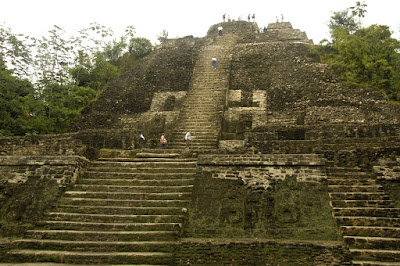


January 14, 2009 by Richard McGuire · Leave a Comment
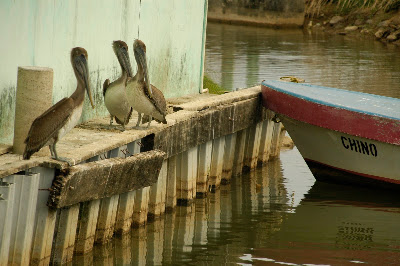
 Dangriga is the spiritual centre of the Garifuna people in Belize, and is the largest town in the south.

January 10, 2009 by Richard McGuire · Leave a Comment
I spent most of yesterday and today travelling, and am now back in Belize — a long way geographically and culturally from Antigua, Guatemala. I’m in Dangriga, on the coast, south of Belize City. It’s the cultural capital of the Garifuna people, an African-influenced culture.
I took a shuttle from Antigua to Guatemala City — a huge congestion of diesel smoke and traffic — and then took a pullman bus across the country to Puerto Barrios on the Caribbean coast. The bus ride was actually pleasant, with a comfortable seat and very nice hilly green scenery. (The only drawback was the action movie that is always played loudly on Latin American luxury buses).
Puerto Barrios is the asshole of Guatemala. Its major function has been as a port to ship bananas going back to the days of United Fruit Company, that ruled Guatemala like a fiefdom and even got the CIA to overthrow the Guatemalan government in the 1950s. Now the big Chiquita containers are owned by Del Monte, and they are trucked alongside the Dole containers with Bob the Banana. The place is otherwise grubby and rundown looking, with the typical rough looking people who hang around port towns.
My $9 room was very depressing, coffin-like, and just outside was the main road where loud trucks hauled containers all through the night. Added to that, I’m recovering from a cold, and not sleeping well.
This morning I took a one-hour ride from Puerto Barrios to Punta Gorda in Belize on a launch holding about 15 passengers, and was very impressed that they actually issued us life jackets — not something to take for granted in these parts. The water was relatively calm, but the waves picked up at the end, sending us lunging and crashing into the spray. Then a three-hour trip on a former school bus stopping everywhere, but at least in Belize they don’t put three people to a seat as in Guatemala.
Dangriga is not a touristy town, though seems interesting. I’m in a little caban next to the river, which is lined with banana trees and other tropical plants. I expect to stay here a few days before heading north.
January 8, 2009 by Richard McGuire · Leave a Comment
 Here are some photos I took yesterday showing some of the colonial architecture of Antigua, Guatemala. These go with my post from last night.


January 7, 2009 by Richard McGuire · Leave a Comment
I took a minibus today to Antigua, the former colonial capital of Guatemala. The bus was a tourist bus, but it was certainly worth the couple dollars extra to have a seat to myself and a place to put my legs.
Antigua is a beautiful city surrounded by three volcanoes, and with cobbled streets and colonial architecture. Much of it was destroyed by an earthquake in the 1700s, which is why the capital was moved to Guatemala City, but many of the buildings were rebuilt — with fewer stories, and many of the old ruins remain — such as churches with no roofs.
It was here that I lived several months in 1993 when I took an intensive Spanish immersion course. My school has moved, and the building is now a hotel, but I saw many old landmarks, like the park I used to walk past everyday that has public laundry washing basins.
I will spend two nights here with a full day tomorrow to explore, and hopefully post some pictures later. Then on Friday, I take a bus — one of the few comfortable bus services — across Guatemala to Puerto Barrios on the Caribbean coast, which is the jumping off point for a boat to Belize on my way home.
January 6, 2009 by Richard McGuire · Leave a Comment
 Today was market day in Sololá, the main town up the mountain from Panajachel. Unlike some of the other markets, like Chichicastenango, that feature items geared to tourists, this one is mainly for the local indigenous people. In this area the costumes are particularly interesting as people from different villages wear different outfits.
Here again I took pictures of a group of cofradia parading through the streets and collecting money from people (first two photos), as well as many of people and interesting products.
This is the last of the markets I plan to visit. Tomorrow I head to the former colonial capital of Antigua for a couple of days. It was there that I studied Spanish for seven weeks in 1993.


